Currently Empty: $0.00
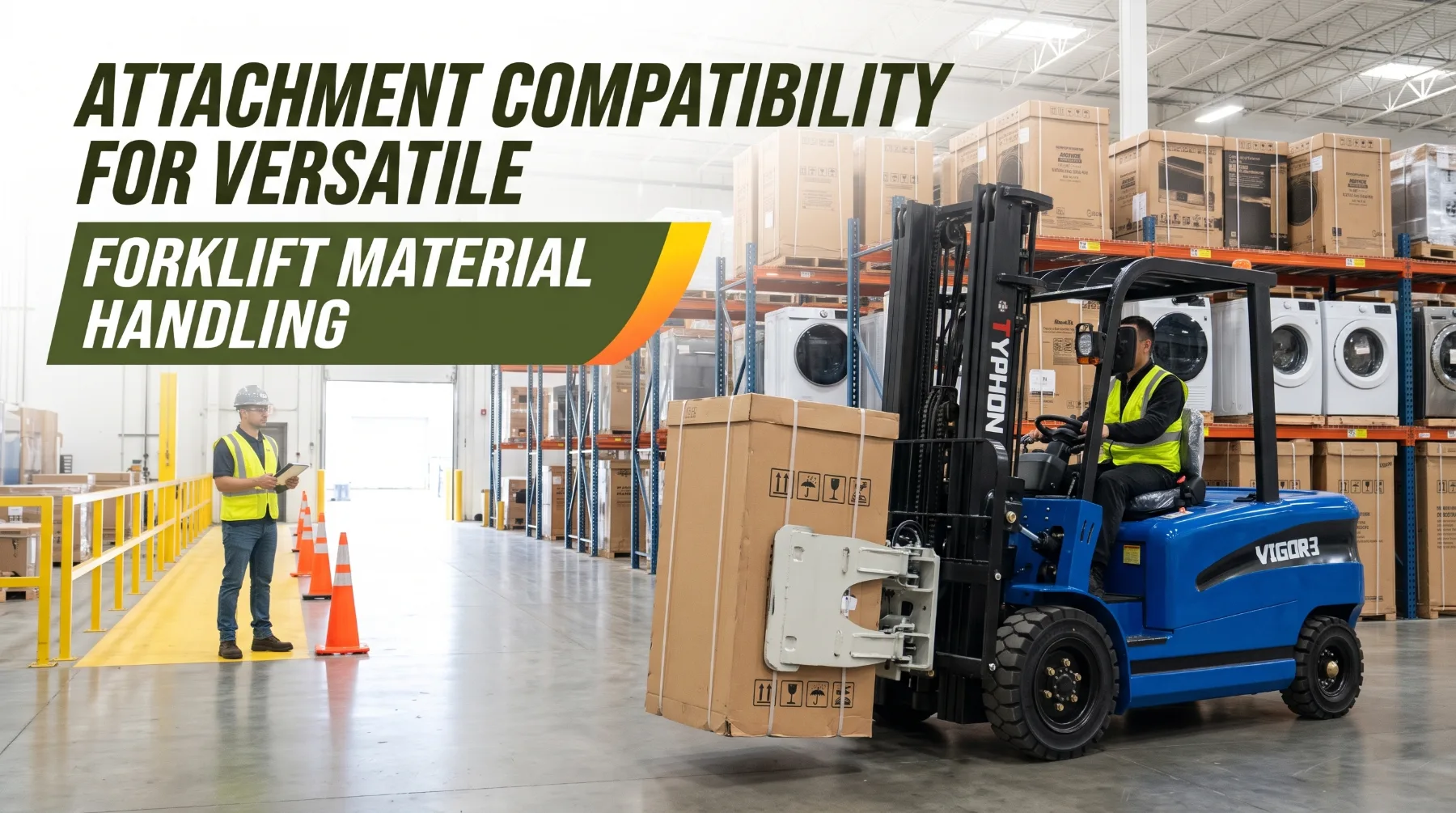
Attachment Compatibility for Versatile Forklift Material Handling
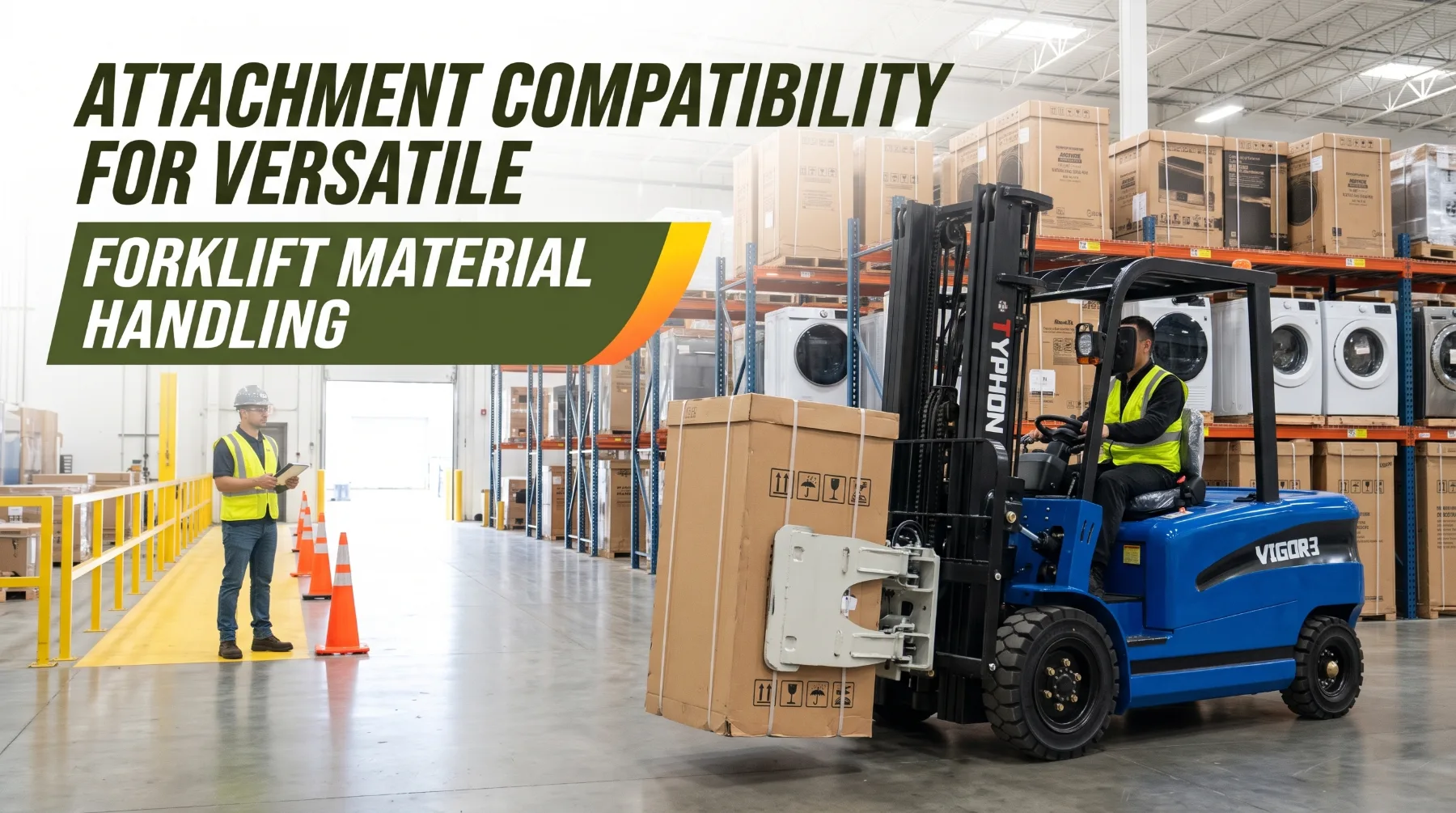
Material handling operations often require forklifts to move different types of loads across warehouses, manufacturing facilities, and distribution yards. Attachments such as sideshifters, fork positioners, carton clamps, and rotators expand what a forklift can handle beyond standard pallet movement. However, adding an attachment changes how the truck operates and can affect its lifting capacity, hydraulic functions, and load stability.
Compatibility involves more than matching the attachment's mounting class to the forklift carriage. Operators and fleet managers must also consider hydraulic flow and auxiliary functions, attachment weight, load center, clamping force, and the forklift's rated capacity with the attachment installed. Incorrect pressure settings or unsuitable attachment configurations can damage products, interfere with existing functions, or make loads unstable.
Proper selection starts with matching the attachment to the material, handling requirements, and forklift specifications. Qualified personnel should verify hydraulic compatibility, confirm the revised capacity information on the manufacturer's approved data plate, and ensure the attachment is correctly installed and adjusted. Regular inspections, operator training, and adherence to manufacturer instructions help maintain safe handling performance and protect both equipment and materials.
Matching Attachments to Material Handling Tasks
Start with the loads, not the catalog. List what your forklifts handle every day, including load type, dimensions, weight, packaging, and how often each load moves. Then describe the movement each load requires, such as lifting from the floor, placing into racking, loading trailers, stacking without pallets, or tipping contents into a hopper. That simple inventory tells you which forklift attachments will save time and which ones will sit unused in the corner.
Standard forks handle a large share of palletized forklift material handling. They suit most wood and plastic pallets, crates with fork pockets, and skids. When a forklift with standard forks works well for your loads, adding an attachment only adds weight, cost, and maintenance. Choose attachments where they solve a real, recurring problem.
Several common attachments cover most needs:
- Sideshifter: A sideshifter forklift moves the forks and load laterally, often about 4 inches in each direction, so the operator can line up with racks and trailer walls without repositioning the whole truck. Sideshifters are among the most widely used forklift attachments because they save time and reduce rack and product damage.
- Fork positioner: A fork positioner adjusts fork spacing hydraulically from the seat. It suits operations that handle many pallet widths, such as mixed-freight docks and beverage distribution. Many units combine fork positioning and sideshift in one attachment.
- Clamps: A forklift clamp attachment grips loads by squeezing them between two arms or pads. Carton clamps handle appliances and boxed goods, paper roll clamps handle rolls, and bale clamps handle cotton, recycled material, and textiles. Clamps eliminate pallets for suitable products.
- Rotator: A forklift rotator turns the carriage and forks, or another attachment, to dump bins, invert containers, or orient loads. Rotators are common in food processing, foundries, and recycling yards.
- Specialized tools: Push-pull attachments handle slip sheets, carpet poles handle rolled goods, drum handlers lift barrels, and fork extensions handle oversized loads within the manufacturer's limits.
Match each attachment to the actual load shape, load weight, and handling frequency. A clamp may sound versatile, but it only works with products that can withstand clamping force without crushing or slipping. A rotator adds value only if your workflow actually requires dumping or turning loads. When loads vary widely, a multi-function attachment may outperform several single-purpose tools, as long as its weight doesn't cut too deeply into forklift rated capacity. Also, evaluate load weight and battery runtime together, since heavier loads and frequent handling can increase energy consumption and reduce operating time between charges.
Ask the attachment manufacturer to confirm the tool suits your products, packaging, and duty cycle. Request recommended clamp force ranges, pad types, and handling limits for the loads you plan to move. A short trial with your own products often reveals issues that spec sheets don't.
Key takeaway: Choose forklift attachments based on the loads, movements, and handling frequency in your operation. Standard forks remain the right choice for many pallets, while sideshifters, fork positioners, clamps, and rotators earn their place when they solve recurring problems.
Checking Forklift Carriage Compatibility
The carriage is the mounting structure that connects forks and attachments to the forklift's mast. Most hook-type forklift attachments hang on the carriage's upper bar and are retained by lower hooks on the bottom bar. If the carriage and attachment don't match, the attachment can't mount securely, and every load it carries is at risk.
Exact capacity boundaries vary slightly between standards and manufacturers, so check the carriage itself rather than assuming from the truck's rating. Measure the distance from the top of the upper bar to the bottom of the lower bar and compare it with the attachment's mounting class.
Matching the class alone doesn't confirm complete forklift attachment compatibility. Check carriage width, since an attachment wider or narrower than the carriage may not seat correctly or may leave lower hooks unsupported. Confirm the hook arrangement and the location of the center notch on the upper bar, which keeps many attachments centered and prevents sideways drift. Check whether the carriage includes an integral sideshifter, since some attachments are designed to hang on a fixed carriage only.
Clearances matter throughout the lift and tilt range. The attachment must clear the mast channels, lift chains, hose routing, overhead guard, and load backrest during full lift and full tilt. Some attachments are thick enough that the mast can't tilt fully forward or back without contact. Others extend beyond the truck's width, which affects aisle clearance. Ask for dimensional drawings and verify them against the exact truck model and mast.
Key takeaway: Confirm forklift carriage class, carriage width, hook arrangement, and full lift-and-tilt clearances for the exact truck. A matching class number is a starting point, not proof of forklift attachment compatibility.
Understanding Attachment Effects on Rated Capacity
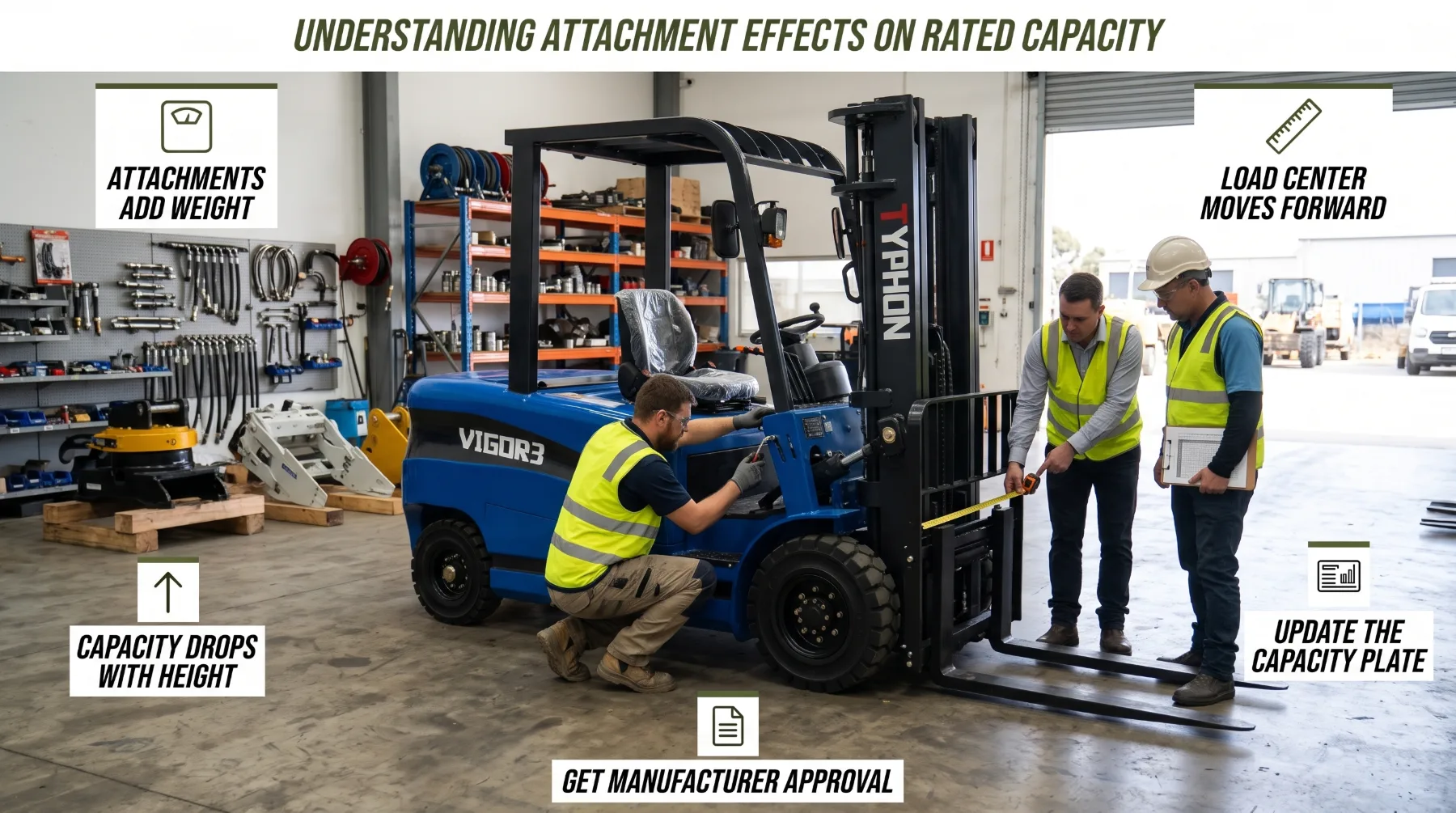
Every forklift attachment changes how much the truck can safely lift. Attachments add weight to the front of the truck, and most also move the load farther from the mast. Both effects work against the counterweight, which reduces forklift rated capacity. Operators who assume the original rating still applies are working from the wrong number, as the opening scenario showed.
Lift height matters too. Many forklift capacity plate ratings decrease at higher lift heights, especially on three- and four-stage masts. An attachment that fits within capacity at 10 feet may exceed it at the top rack level. Off-center loads, such as a clamped carton gripped near one end or a rotated load, reduce stability further.
Request a revised capacity rating from the truck manufacturer or authorized dealer for every attachment you install. The updated forklift capacity plate should show the approved attachment, load center, lift heights, and allowable loads. Keep a copy of the approval on file, and train operators to read the new plate before lifting. When a truck uses more than one attachment over time, make sure the correct plate or rating applies to the attachment currently mounted.
Hydraulic Flow and Pressure Requirements
Many forklift attachments use hydraulic power to shift, position, clamp, rotate, or push loads. These forklift hydraulic attachments depend on the truck to supply the right number of functions, the right flow, and the right pressure. A mismatch can make an attachment slow, weak, erratic, or dangerous.
Count the functions first. Lift and tilt are the forklift's standard hydraulic functions. Each additional movement needs its own auxiliary function. A sideshifter forklift uses one auxiliary function. A fork positioner with integral sideshift needs two. A clamp with sideshift needs two, and a rotating clamp may need three. Each function requires a valve section, a control lever or switch, and hoses routed up the mast. Many trucks add functions with additional valve sections or an electric solenoid diverter valve that shares one hydraulic circuit between two functions. Confirm how many auxiliary functions the truck has, and whether the control arrangement can be expanded to match the attachment.
Hose routing must suit the mast. Hoses travel through the mast on hose reels, sheaves, or internal routing, and three- and four-stage masts often limit how many lines can be added. Fittings, hose sizes, and couplers must match the attachment manufacturer's specifications. Undersized hoses or fittings restrict flow, add heat, and slow the attachment.
Compare flow and pressure with the attachment's published requirements. Each attachment manufacturer lists a recommended flow range and maximum operating pressure. Too little flow makes sideshifting, positioning, or rotation slow. Too much flow can make movements jerky and hard to control. Pressure above the attachment's rating can overload cylinders, motors, and seals, while pressure below it reduces force.
Clamp force deserves special attention. A forklift clamp attachment grips loads with force set by hydraulic pressure. Too little clamp force lets loads slip. Too much crushes cartons, deforms paper rolls, and damages products. Many clamps use pressure-limiting or regulating valves, sometimes with selectable settings for different products. Follow the attachment manufacturer's recommended clamp force for each load type, and have qualified technicians set and verify it with a gauge. The crushed refrigerator cartons in the opening scenario came from a clamp running on unregulated system pressure.
Rotators and clamps also need load-holding protection. Many include check valves or counterbalance valves that help hold position if a hose fails or a control is released. Never bypass these valves or substitute generic parts.
Electrical connections may be required as well. Attachments with solenoid valves, sensors, or electronic controls need compatible connectors, voltage, and wiring routed safely up the mast. Some modern trucks require dealer programming to enable or adjust auxiliary functions. Request written confirmation that the truck's hydraulic and electrical systems match the attachment's requirements before installation.
Key takeaway: Forklift hydraulic attachments need the right number of auxiliary functions, suitable hose routing, and flow and pressure within the attachment's range. Regulate clamp force for each product, keep load-holding valves intact, and confirm electrical compatibility.
Visibility, Stability, and Operator Control
An attachment changes how the forklift looks, feels, and behaves from the seat. Large clamps, rotators, and push-pulls can block the operator's view of the load, fork tips, rack beams, and travel path. Added weight and a forward load position change how the truck responds when lifting high, braking, and turning. Operators need training that covers these changes before they put the attachment to work.
Controls must be clear and consistent. Every auxiliary function should have a clearly labeled lever, button, or joystick function, and the labeling should match across the fleet where possible. Unfamiliar or inconsistent control layouts lead to mistakes, such as opening a clamp when the operator meant to sideshift. Some clamps include a release interlock that requires two actions to open the arms, which helps prevent accidental drops.
Inspection and Maintenance of Forklift Attachments
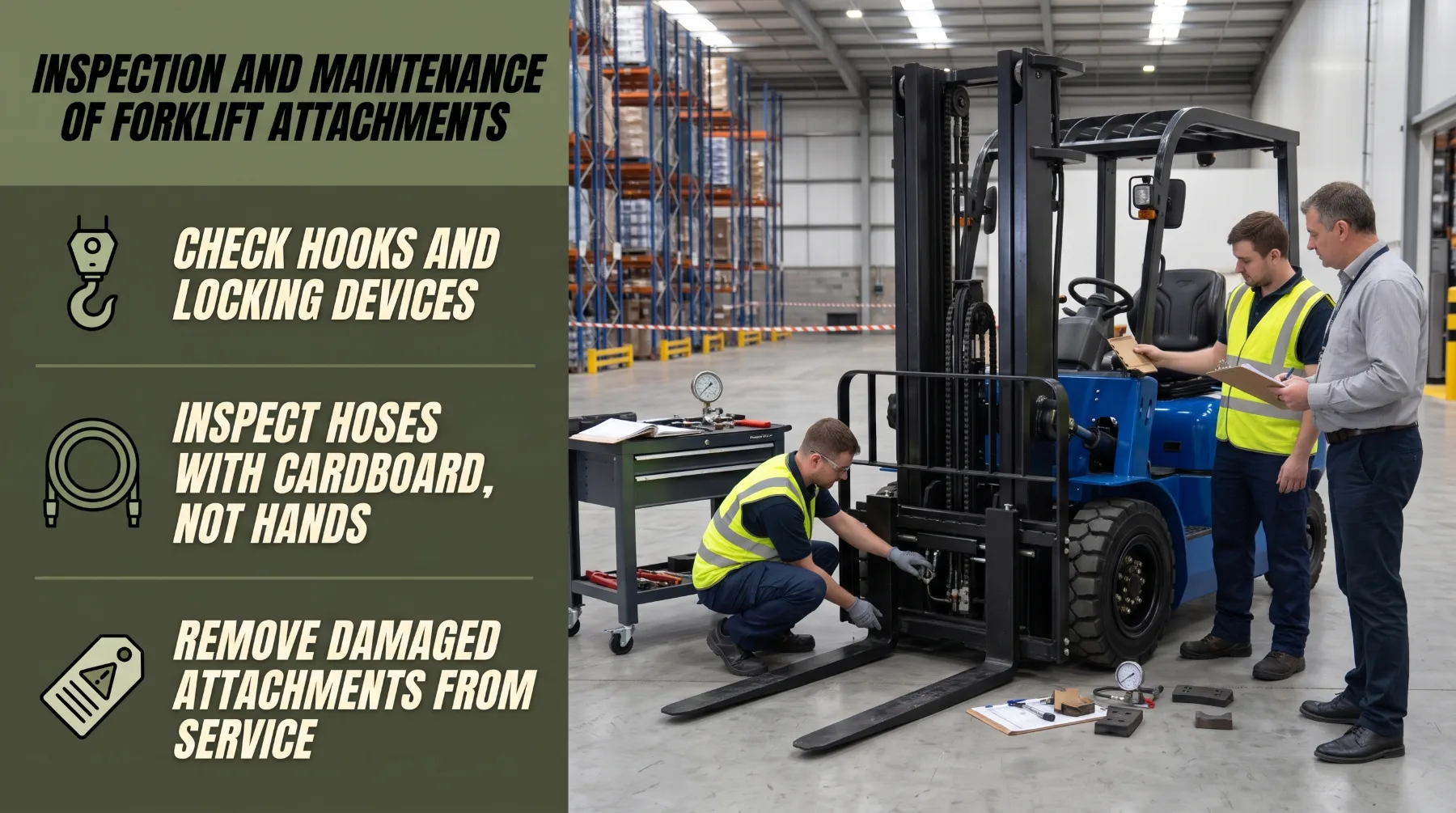
Forklift attachments take steady abuse from loads, racks, trailers, and dock plates. Hooks wear, welds crack, hoses chafe on the mast, and clamp pads tear. Regular inspection keeps each attachment secure and compatible with the truck, and it catches small problems before they drop a load or damage the forklift.
Use a consistent checklist:
- Mounting: Confirm upper hooks are fully seated on the carriage bar and engaged with the center notch where applicable. Check that lower hooks are present, tight, and properly adjusted.
- Locking devices: Verify fork retaining pins, latches, and positioning locks engage fully.
- Structure: Inspect welds, frames, arms, and carriage plates for cracks, bends, and impact damage.
- Contact surfaces: Check clamp pads, fork blades, and contact surfaces for wear, tears, contamination, or missing fasteners.
- Hydraulics: Look for leaks at cylinders, fittings, and couplers, and inspect hoses for abrasion, kinks, and pinching along the mast.
- Function: Operate each auxiliary function through its full range and confirm smooth, controlled movement without drifting.
Never use your hands to search for a hydraulic leak. Pressurized fluid can penetrate skin and cause serious injury that requires immediate medical treatment. Use a piece of cardboard or wood, and wear gloves and eye protection.
Plan for long-term support when you buy. Ask about replacement parts availability, dealer service coverage, repair turnaround time, and technician training for each attachment. Keep records of every inspection, adjustment, and repair, so recurring problems become visible early and warranty claims stay supported.
Conclusion
Forklift attachments expand material handling capabilities by allowing operators to shift, position, clamp, rotate, and push loads across different applications. Safe and efficient operation depends on proper attachment compatibility. Each attachment must suit the load and task while matching the forklift’s carriage class, carriage width, and required clearances. Attachment weight and effective thickness reduce the truck’s available rated capacity, so the capacity plate must reflect the approved configuration. Hydraulic attachments also require compatible functions, flow, pressure, and clamping force. Visibility, machine stability, and operator training are equally important for safe handling. When selecting an attachment, identify the loads your crews handle, their weights, and the movements required. Request carriage specifications, dimensional drawings, hydraulic requirements, and a revised capacity rating in writing for the exact forklift and attachment combination. Ensure the capacity plate is updated, train all operators, and include attachment condition and connection checks in every pre-shift inspection. Proper compatibility and maintenance improve handling efficiency, protect materials, and support safer daily operations.
Frequently Asked Questions
Do forklift attachments reduce lifting capacity?
They can, and most do. Attachment weight sits ahead of the front axle, and the attachment's thickness moves the load center forward, which increases leverage against the counterweight. Get a revised forklift rated capacity from the manufacturer or authorized dealer for each attachment, and never assume the original rating still applies.
Do all forklift attachments require hydraulic connections?
No. Some attachments are mechanical, such as fork extensions and certain carpet poles. Others need one or more hydraulic functions, such as a sideshifter forklift, a fork positioner, a forklift clamp attachment, or a forklift rotator. Some also require electrical connections for solenoid valves or electronic controls.
What should buyers check before purchasing a forklift attachment?
Check forklift carriage class, carriage width, mounting dimensions, and clearances, along with the revised rated capacity and load center. Confirm the number of auxiliary hydraulic functions, flow, pressure, clamp force regulation, and electrical requirements. Review visibility, operator controls, and training needs, and request written manufacturer approval for the exact truck and attachment combination.